Crypto Toolbox Talk
Crypto Toolbox Talk: How Do You Actually Set Up Crypto Twitter?
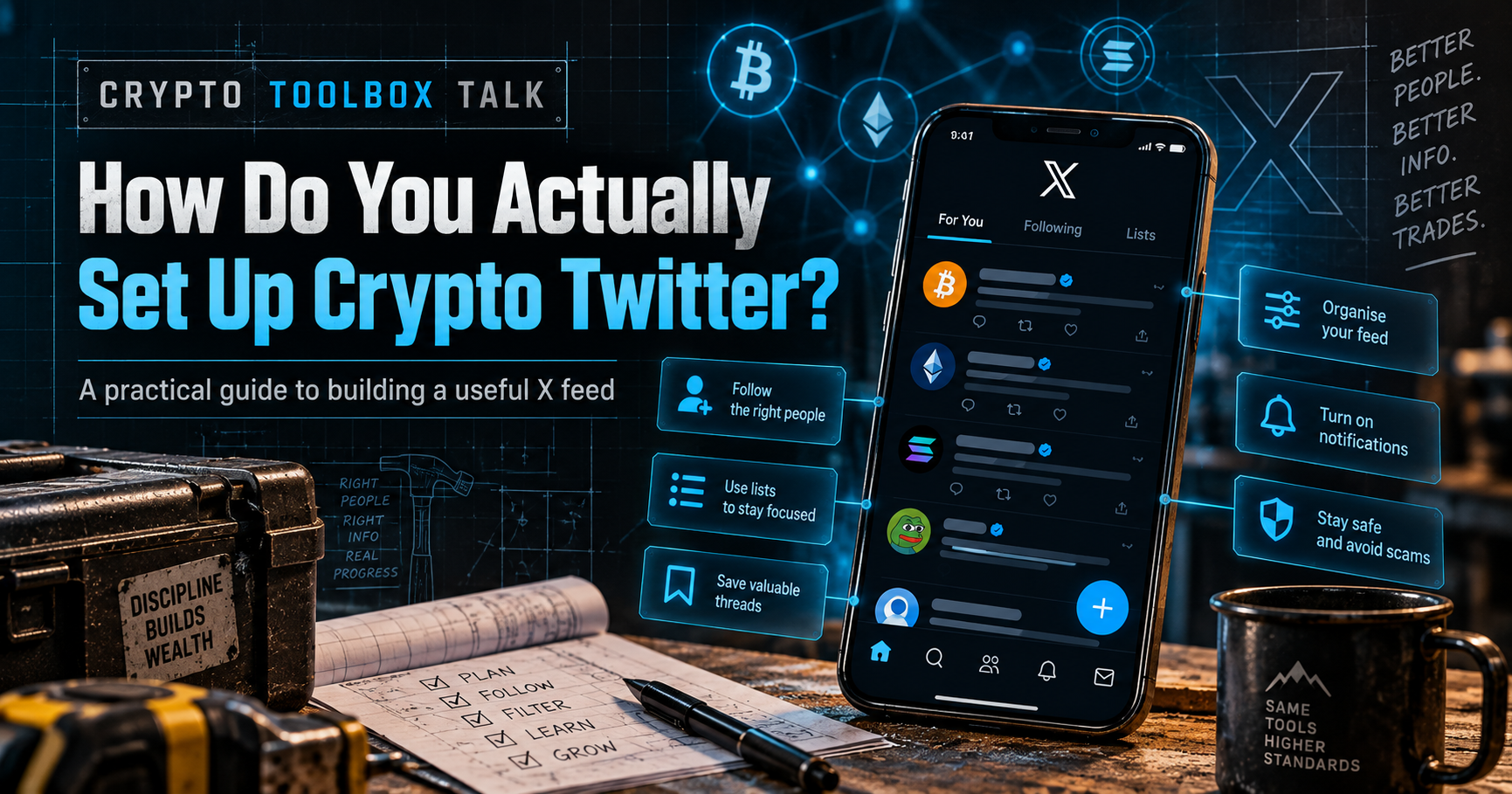
You don't need a special account to join Crypto Twitter. Here's how to turn a normal X account into a useful crypto resource without filling your feed with hype, scams and noise.
In the last Toolbox Talk, we answered a question that confused me for longer than I'd like to admit:
What exactly is Crypto Twitter?
The answer was surprisingly simple.
Crypto Twitter — or CT — isn't another app or a special section of the internet.
It's just the crypto conversation happening on X.
That leads to the next obvious question:
How do you actually set it up?
Do you need a new account?
Who should you follow?
How do you keep your feed from becoming nothing but price predictions, memes, arguments and people telling you they've found the next 100x token?
That's what we're going to tackle today.
And the good news is that you don't need anything complicated.
You probably don't need another X account
Let's start here.
You do not need a dedicated crypto account to use Crypto Twitter.
If you already have an X account, you can start building a useful crypto feed from the account you already have.
Some people do create separate crypto accounts because they want to keep work, family or other interests separate.
That's fine too.
But there's no technical reason you need one.
Crypto Twitter isn't something you sign up for.
You build it.
Think about setting up a new toolbox
If you buy a new toolbox for the jobsite, you don't immediately throw every tool you've ever seen into it.
You start with the things you actually need.
Then you add tools as you learn what works.
Your Crypto Twitter feed should work the same way.
The goal isn't to follow everybody talking about crypto.
The goal is to build a collection of people and sources that help you understand it.
Start with the official sources
This is probably the most important thing I would tell somebody starting out.
Before following influencers, traders or people with laser eyes in their profile pictures, start with the actual companies, projects and organizations you're interested in.
If you use an exchange, find its official account.
If you hold a cryptocurrency, find the project's official account.
If you're interested in a particular blockchain, find the network, developers and ecosystem accounts connected to it.
If a wallet or service you use has an official account, follow it.
Why?
Because Crypto Twitter is incredibly fast.
Unfortunately, rumors are fast too.
Following primary sources gives you somewhere to check when everybody else starts talking.
It's the same rule we talked about in the first Toolbox Talk:
Don't rebuild the wall because somebody at break said the drawings changed. Check the drawings.
Then add people who actually teach you something
Once you have your official sources, start adding individuals.
This part takes time.
Look for people who:
You don't need to agree with everyone you follow.
In fact, you probably shouldn't.
A useful feed exposes you to different ideas.
A useless feed just keeps telling you that everything you already believe is correct.
Be careful who you let build your feed
X learns from what you interact with.
That means every follow, like, reply, click and conversation can help shape what eventually shows up in front of you.
That's useful.
It can also create a mess pretty quickly.
Spend a week clicking nothing but posts about the next 100x meme coin and you'll probably start seeing a lot more posts about the next 100x meme coin.
Spend your time reading developers, official project updates, security information and thoughtful educational content and you'll start building a very different experience.
In other words:
You're not just scrolling the feed. You're training it.
Be intentional about what you give your attention to.
Use Lists — they're one of the best tools on X
This is something I wish more people used.
X Lists let you create separate feeds made up of specific accounts.
For example, you could create Lists for:
Official Sources
Projects, exchanges, wallets and networks you actually use.
Builders
Developers, founders and people building things in the space.
Crypto News
Journalists, researchers and news organizations.
Projects I'm Following
Accounts connected to projects you want to keep an eye on.
Lists can also be private.
That means you can organize your research without broadcasting every project or account you're watching.
And here's another useful feature:
You don't even have to follow an account to put it on one of your Lists.
That's a pretty powerful way to separate useful information from your normal timeline.
Your Following feed can be more useful than For You
The For You feed is great for discovering things.
It's also where algorithms can take you down some interesting rabbit holes.
Your Following feed gives you much more control because you're looking at accounts you deliberately chose to follow.
I use both differently.
Think of For You as walking around the entire jobsite.
You might stumble across something interesting.
Think of Following or a well-built List as walking directly to the crew you came there to talk to.
When you're trying to research something specific, control matters.
Use Bookmarks like a parts bin
See something useful but don't have time to dig into it?
Bookmark it.
Bookmarks are private, so nobody else sees what you're saving.
I like thinking of them as a parts bin.
Maybe you find:
a technical explanation you want to read later,
a project announcement you want to verify,
a wallet tutorial,
a research thread,
or something you don't completely understand yet.
You don't need to make a decision right then.
Save it.
Come back when you have time to actually look at it.
Crypto rewards patience a lot more often than social media makes it seem.
Mute is your friend
Here's another lesson that applies equally well to a jobsite:
You don't have to listen to everybody.
X lets you mute accounts, words, phrases and notifications.
Use it.
If your feed becomes overwhelmed with something you don't care about, clean it up.
If an account constantly posts rage bait, engagement farming or nonsense but you don't necessarily want to block them, mute them.
Your attention has value.
Protect it.
Secure the account before you start wandering around
If you're going to use X as part of your crypto life, account security matters.
Use a unique password.
Turn on two-factor authentication.
Make sure you still control the email address connected to the account.
Be suspicious of unexpected login messages.
And remember something extremely important:
Your X account and your crypto wallet should never require you to give another person your seed phrase.
Nobody from X needs it.
Nobody from an exchange needs it.
Nobody from a crypto project needs it.
Nobody helping you in a DM needs it.
If someone asks for your seed phrase, the conversation is over.
Be extremely careful with links
Crypto Twitter contains a lot of legitimate links.
It also contains fake ones.
Scammers clone websites, impersonate projects and create accounts that can look surprisingly convincing at first glance.
A post might tell you:
Claim your rewards.
Connect your wallet.
Mint now.
Migration required.
Verify your wallet.
Limited time.
Act immediately.
Those words should make you slow down, not speed up.
If an important project is asking users to take action, verify it through multiple official sources before connecting a wallet or signing anything.
Urgency is one of the oldest tools in the scam toolbox.
You don't have to connect a wallet to participate in Crypto Twitter
This is worth saying plainly.
You can learn a tremendous amount on Crypto Twitter without connecting a crypto wallet to anything.
Following accounts doesn't require a wallet.
Reading posts doesn't require a wallet.
Joining conversations doesn't require a wallet.
Creating Lists doesn't require a wallet.
Learning doesn't require a wallet.
Don't let somebody convince you that connecting your wallet is just a normal part of reading about crypto.
It isn't.
Connect wallets when there's an actual reason to interact with a blockchain application — not because a random post told you to.
Don't worry about building the perfect feed on day one
Your Crypto Twitter feed will change.
Mine has.
Projects come and go.
People change what they talk about.
You discover new areas of crypto.
Some accounts that looked valuable six months ago stop being useful.
That's normal.
Treat your feed like a toolbox.
Keep what works.
Remove what doesn't.
Add better tools when you find them.
A simple way to start
If I were building a Crypto Twitter account from scratch today, I'd keep the first setup pretty simple:
1. Secure the account and enable two-factor authentication.
2. Clean up the profile so people know there's a real person behind it.
3. Follow the official accounts for the projects, exchanges and wallets you actually use.
4. Add a handful of good educators, developers, researchers and builders.
5. Create at least one private List for important sources.
6. Use Bookmarks for things you want to research later.
7. Spend some time reading before following hundreds of accounts.
8. Engage with useful content so your feed begins learning what you actually want to see.
9. Mute noise aggressively.
10. Never trust a financial or wallet-related DM just because the account looks legitimate.
That's enough.
You don't need 2,000 follows.
You don't need a paid trading group.
You don't need ten Telegram channels screaming alerts at you.
You need a useful collection of sources and enough patience to figure out which ones deserve your attention.
🔨 Toolbox Takeaway
You don't really "join" Crypto Twitter.
You build your version of it.
Start with primary sources.
Add people who consistently teach you something.
Organize important accounts with Lists.
Save useful information with Bookmarks.
Control the noise.
Protect your account.
And remember that seeing something on X is the beginning of your research — not the end of it.
The goal isn't to know everything happening in crypto.
Nobody does.
The goal is to build a feed that helps you learn without letting the noise make decisions for you.
That's the same approach I'm taking with this series.
I'm a tradesman who's been around crypto for years, and I still run into things that make me stop and ask:
What does that actually mean?
When I do, we'll open the toolbox and figure it out.
Crypto explained by a tradesman, for tradespeople.
Next Toolbox Talk:
Who Can You Actually Trust on Crypto Twitter?
We'll look at blue checks, follower counts, influencers, developers, official accounts, fake accounts and some practical ways to decide whether a source deserves your attention.
What exactly is Crypto Twitter?
The answer was surprisingly simple.
Crypto Twitter — or CT — isn't another app or a special section of the internet.
It's just the crypto conversation happening on X.
That leads to the next obvious question:
How do you actually set it up?
Do you need a new account?
Who should you follow?
How do you keep your feed from becoming nothing but price predictions, memes, arguments and people telling you they've found the next 100x token?
That's what we're going to tackle today.
And the good news is that you don't need anything complicated.
You probably don't need another X account
Let's start here.
You do not need a dedicated crypto account to use Crypto Twitter.
If you already have an X account, you can start building a useful crypto feed from the account you already have.
Some people do create separate crypto accounts because they want to keep work, family or other interests separate.
That's fine too.
But there's no technical reason you need one.
Crypto Twitter isn't something you sign up for.
You build it.
Think about setting up a new toolbox
If you buy a new toolbox for the jobsite, you don't immediately throw every tool you've ever seen into it.
You start with the things you actually need.
Then you add tools as you learn what works.
Your Crypto Twitter feed should work the same way.
The goal isn't to follow everybody talking about crypto.
The goal is to build a collection of people and sources that help you understand it.
Start with the official sources
This is probably the most important thing I would tell somebody starting out.
Before following influencers, traders or people with laser eyes in their profile pictures, start with the actual companies, projects and organizations you're interested in.
If you use an exchange, find its official account.
If you hold a cryptocurrency, find the project's official account.
If you're interested in a particular blockchain, find the network, developers and ecosystem accounts connected to it.
If a wallet or service you use has an official account, follow it.
Why?
Because Crypto Twitter is incredibly fast.
Unfortunately, rumors are fast too.
Following primary sources gives you somewhere to check when everybody else starts talking.
It's the same rule we talked about in the first Toolbox Talk:
Don't rebuild the wall because somebody at break said the drawings changed. Check the drawings.
Then add people who actually teach you something
Once you have your official sources, start adding individuals.
This part takes time.
Look for people who:
- explain why something matters instead of just saying it's bullish or bearish
- link back to original sources
- admit when they're unsure
- correct themselves when they're wrong
- teach you something even when you disagree with them
- talk about technology and adoption, not only price
- have experience in the part of crypto they're discussing
You don't need to agree with everyone you follow.
In fact, you probably shouldn't.
A useful feed exposes you to different ideas.
A useless feed just keeps telling you that everything you already believe is correct.
Be careful who you let build your feed
X learns from what you interact with.
That means every follow, like, reply, click and conversation can help shape what eventually shows up in front of you.
That's useful.
It can also create a mess pretty quickly.
Spend a week clicking nothing but posts about the next 100x meme coin and you'll probably start seeing a lot more posts about the next 100x meme coin.
Spend your time reading developers, official project updates, security information and thoughtful educational content and you'll start building a very different experience.
In other words:
You're not just scrolling the feed. You're training it.
Be intentional about what you give your attention to.
Use Lists — they're one of the best tools on X
This is something I wish more people used.
X Lists let you create separate feeds made up of specific accounts.
For example, you could create Lists for:
Official Sources
Projects, exchanges, wallets and networks you actually use.
Builders
Developers, founders and people building things in the space.
Crypto News
Journalists, researchers and news organizations.
Projects I'm Following
Accounts connected to projects you want to keep an eye on.
Lists can also be private.
That means you can organize your research without broadcasting every project or account you're watching.
And here's another useful feature:
You don't even have to follow an account to put it on one of your Lists.
That's a pretty powerful way to separate useful information from your normal timeline.
Your Following feed can be more useful than For You
The For You feed is great for discovering things.
It's also where algorithms can take you down some interesting rabbit holes.
Your Following feed gives you much more control because you're looking at accounts you deliberately chose to follow.
I use both differently.
Think of For You as walking around the entire jobsite.
You might stumble across something interesting.
Think of Following or a well-built List as walking directly to the crew you came there to talk to.
When you're trying to research something specific, control matters.
Use Bookmarks like a parts bin
See something useful but don't have time to dig into it?
Bookmark it.
Bookmarks are private, so nobody else sees what you're saving.
I like thinking of them as a parts bin.
Maybe you find:
a technical explanation you want to read later,
a project announcement you want to verify,
a wallet tutorial,
a research thread,
or something you don't completely understand yet.
You don't need to make a decision right then.
Save it.
Come back when you have time to actually look at it.
Crypto rewards patience a lot more often than social media makes it seem.
Mute is your friend
Here's another lesson that applies equally well to a jobsite:
You don't have to listen to everybody.
X lets you mute accounts, words, phrases and notifications.
Use it.
If your feed becomes overwhelmed with something you don't care about, clean it up.
If an account constantly posts rage bait, engagement farming or nonsense but you don't necessarily want to block them, mute them.
Your attention has value.
Protect it.
Secure the account before you start wandering around
If you're going to use X as part of your crypto life, account security matters.
Use a unique password.
Turn on two-factor authentication.
Make sure you still control the email address connected to the account.
Be suspicious of unexpected login messages.
And remember something extremely important:
Your X account and your crypto wallet should never require you to give another person your seed phrase.
Nobody from X needs it.
Nobody from an exchange needs it.
Nobody from a crypto project needs it.
Nobody helping you in a DM needs it.
If someone asks for your seed phrase, the conversation is over.
Be extremely careful with links
Crypto Twitter contains a lot of legitimate links.
It also contains fake ones.
Scammers clone websites, impersonate projects and create accounts that can look surprisingly convincing at first glance.
A post might tell you:
Claim your rewards.
Connect your wallet.
Mint now.
Migration required.
Verify your wallet.
Limited time.
Act immediately.
Those words should make you slow down, not speed up.
If an important project is asking users to take action, verify it through multiple official sources before connecting a wallet or signing anything.
Urgency is one of the oldest tools in the scam toolbox.
You don't have to connect a wallet to participate in Crypto Twitter
This is worth saying plainly.
You can learn a tremendous amount on Crypto Twitter without connecting a crypto wallet to anything.
Following accounts doesn't require a wallet.
Reading posts doesn't require a wallet.
Joining conversations doesn't require a wallet.
Creating Lists doesn't require a wallet.
Learning doesn't require a wallet.
Don't let somebody convince you that connecting your wallet is just a normal part of reading about crypto.
It isn't.
Connect wallets when there's an actual reason to interact with a blockchain application — not because a random post told you to.
Don't worry about building the perfect feed on day one
Your Crypto Twitter feed will change.
Mine has.
Projects come and go.
People change what they talk about.
You discover new areas of crypto.
Some accounts that looked valuable six months ago stop being useful.
That's normal.
Treat your feed like a toolbox.
Keep what works.
Remove what doesn't.
Add better tools when you find them.
A simple way to start
If I were building a Crypto Twitter account from scratch today, I'd keep the first setup pretty simple:
1. Secure the account and enable two-factor authentication.
2. Clean up the profile so people know there's a real person behind it.
3. Follow the official accounts for the projects, exchanges and wallets you actually use.
4. Add a handful of good educators, developers, researchers and builders.
5. Create at least one private List for important sources.
6. Use Bookmarks for things you want to research later.
7. Spend some time reading before following hundreds of accounts.
8. Engage with useful content so your feed begins learning what you actually want to see.
9. Mute noise aggressively.
10. Never trust a financial or wallet-related DM just because the account looks legitimate.
That's enough.
You don't need 2,000 follows.
You don't need a paid trading group.
You don't need ten Telegram channels screaming alerts at you.
You need a useful collection of sources and enough patience to figure out which ones deserve your attention.
🔨 Toolbox Takeaway
You don't really "join" Crypto Twitter.
You build your version of it.
Start with primary sources.
Add people who consistently teach you something.
Organize important accounts with Lists.
Save useful information with Bookmarks.
Control the noise.
Protect your account.
And remember that seeing something on X is the beginning of your research — not the end of it.
The goal isn't to know everything happening in crypto.
Nobody does.
The goal is to build a feed that helps you learn without letting the noise make decisions for you.
That's the same approach I'm taking with this series.
I'm a tradesman who's been around crypto for years, and I still run into things that make me stop and ask:
What does that actually mean?
When I do, we'll open the toolbox and figure it out.
Crypto explained by a tradesman, for tradespeople.
Next Toolbox Talk:
Who Can You Actually Trust on Crypto Twitter?
We'll look at blue checks, follower counts, influencers, developers, official accounts, fake accounts and some practical ways to decide whether a source deserves your attention.